Black Forest Labs Unveils FLUX 3 Image Klein Generation Model
Executive Summary
"Black Forest Labs releases FLUX 3 Image Klein, a 5.6B‑parameter open‑weights model that outperforms larger rivals in text‑to‑image generation and editing. Its impressive efficiency and quality set a new benchmark for accessible AI image synthesis."
Parameter Efficiency Meets Real-World Quality
Black Forest Labs has unveiled FLUX 3 Image Klein, a 5.6‑billion‑parameter open weights model that punches well above its weight class. In internal benchmarks the model tops the Elo rankings for text‑to‑image generation and image editing, outperforming larger open weight alternatives such as Qwen‑Image 2.1 (7B) and Krea 2 (12.9B) and even edging out the closed Ideogram V4.5 and FLUX.2 [pro] despite its modest size. Compared to its predecessor FLUX.2 [klein] at 9B parameters, the new release gains 91 Elo points in text‑to‑image and 70 in image editing while using 38 % fewer parameters, a clear demonstration that architectural refinements from the FLUX 3 family—cross‑modal learnings from video and audio—are translating into measurable quality gains.
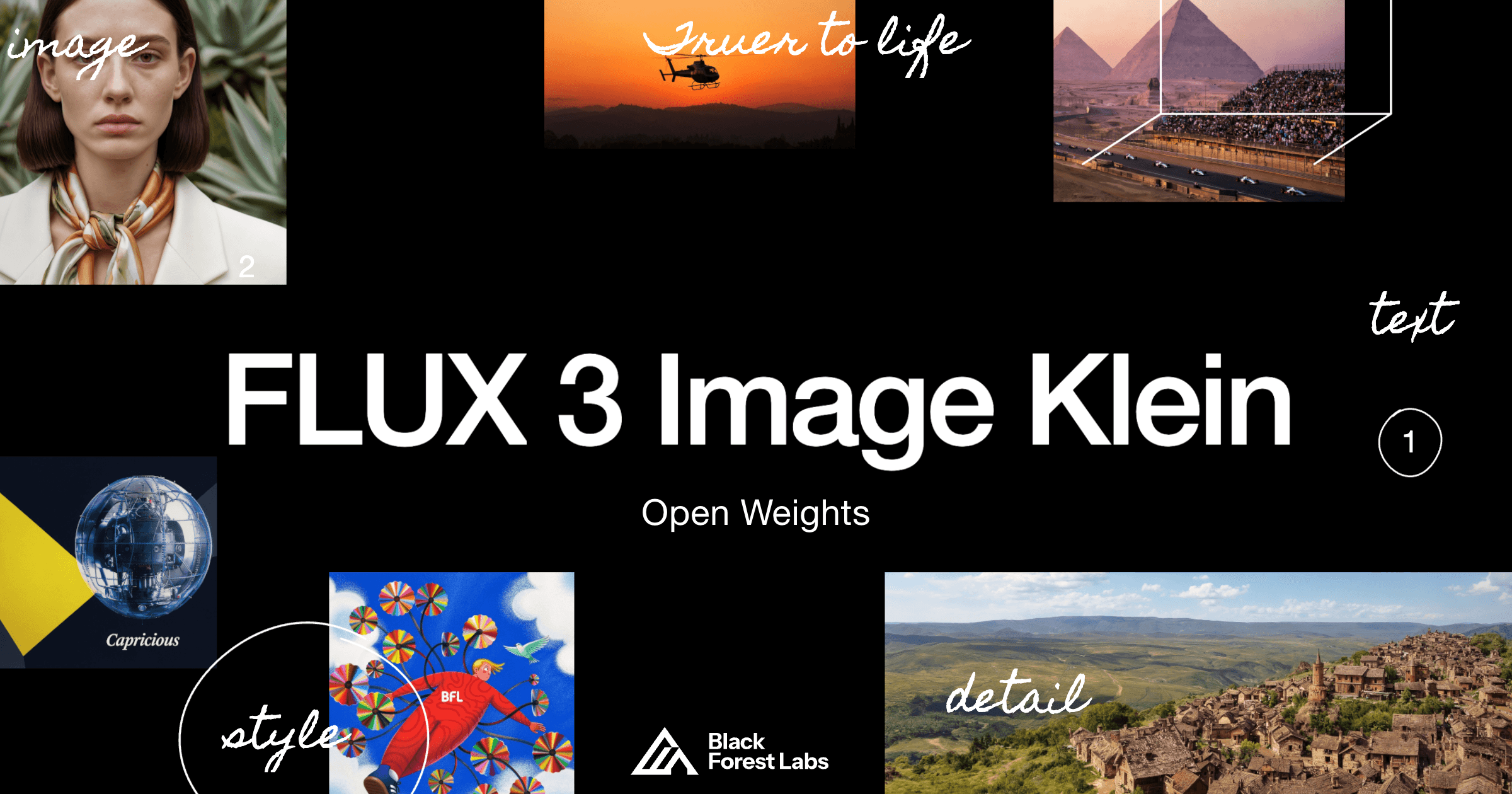
src='https://bfl.ai/_next/image?url=https%3A%2F%2Fcdn.sanity.io%2Fimages%2F2gpum2i6%2Fproduction%2F9897ba388ea1b943dcd51e3ba0bce3070f79d507-2400x1260.png&w=3840&q=75' alt='FLUX 3 Image Klein hero illustration showing the model architecture and key capabilities'The release also includes a visual showcase that highlights the model’s versatility across styles. From detailed illustrations and lifelike portraits to anime‑inspired scenes, stamp designs and crisp typography, the generated images maintain coherence and fine detail even when guided by up to ten reference images. This multi‑reference ability, paired with native 4K generation and pixel‑perfect editing controls, positions FLUX 3 Image Klein as a practical tool for both creative professionals and enterprise pipelines that demand precise composition.
src='https://bfl.ai/_next/image?url=https%3A%2F%2Fcdn.sanity.io%2Fimages%2F2gpum2i6%2Fproduction%2Feada5ee663c5523ab6d43c858baaf037867d324e-2000x1344.webp&w=3840&q=75' alt='Collage of FLUX 3 Image Klein outputs spanning illustration, portrait, photography, anime, stamp design and typography' src='https://bfl.ai/_next/image?url=https%3A%2F%2Fcdn.sanity.io%2Fimages%2F2gpum2i6%2Fproduction%2F1cc58ca0649334f7f1557c983b3b219f2bef9379-1888x788.png&w=3840&q=75' alt='Elo rating versus generator parameters chart showing FLUX 3 Image Klein leading at 5.6B parameters'Speed on Consumer GPUs
Efficiency is not just a paper metric; the model is engineered to run on hardware that many developers already own. With FP8, INT8 and NVFP4 builds co‑developed with NVIDIA, the generator weights occupy only 5.6 GB in INT8 format, enabling inference on GeForce RTX cards with as little as 8 GB of VRAM. In practice, the step‑distilled variant produces a 1‑megapixel image in roughly 4 seconds on an RTX 5090 and under 9 seconds on an RTX 4070 when accessed through ComfyUI or the Hugging Face Diffusers pipeline. Even the full‑precision base model, which requires 50 sampling steps, stays within a usable window for interactive workflows, completing a 1024×1024 image in about 1.7 seconds on a GB300 server and under 44 seconds on a DGX Spark workstation.
src='https://bfl.ai/_next/image?url=https%3A%2F%2Fcdn.sanity.io%2Fimages%2F2gpum2i6%2Fproduction%2Fb43aa0509192765a51274c30875ddcbefb963859-1568x974.png&w=3840&q=75' alt='Generation time by GPU for the step‑distilled model, 16 steps, showing latency from GB300 to RTX 4070' src='https://bfl.ai/_next/image?url=https%3A%2F%2Fcdn.sanity.io%2Fimages%2F2gpum2i6%2Fproduction%2F1c8179858d888670db2c1486f61024e6710509ff-1568x974.png&w=3840&q=75' alt='Generation time by GPU for the base model, 50 steps, showing latency from GB300/DGX Station to DGX Spark' src='https://bfl.ai/_next/image?url=https%3A%2F%2Fcdn.sanity.io%2Fimages%2F2gpum2i6%2Fproduction%2Fa1e83f645466d8d5ea8fb6bfa3a6e6e2489b3af2-1888x788.png&w=3840&q=75' alt='Elo rating versus median API latency at 1 MP, showing FLUX 3 Image Klein as the fastest among top‑rated models'Open Licensing and Safety First
Beyond raw performance, Black Forest Labs continues to pair capability with responsibility. The weights are released under the FLUX Kommunity License, which permits free commercial use for individuals and companies whose annual revenue stays below $5 million, while larger organizations can opt for self‑hosted commercial licenses or API access. Safety measures have been woven into the training pipeline: pretraining data filters limit exposure to harmful content, targeted post‑training fine‑tuning suppresses undesirable behaviors, and external red‑team evaluations by partner Cinder revealed substantially fewer vulnerabilities than those found in competing open models. This commitment to openness without compromising safety helps address enterprise concerns about liability and regulatory compliance.
Market Implications and Outlook
The arrival of FLUX 3 Image Klein reshapes the competitive landscape for generative image models. By delivering top‑tier quality at a fraction of the parameter cost, the model lowers the barrier to entry for startups and indie developers who previously relied on larger, more expensive alternatives. Enterprises with strict data‑sovereignty requirements can now run sophisticated image generation on‑premises using modest GPU hardware, reducing latency and cloud‑cost overhead. Meanwhile, the model’s permissive licensing encourages broader ecosystem integration—evident in day‑one support for ComfyUI, Diffusers, TensorRT‑LLM, SGLang and vLLM‑Omni—potentially accelerating adoption across creative software, advertising tech and product design pipelines. As the FLUX 3 family continues to expand with forthcoming releases, FLUX 3 Image Klein establishes a clear precedent: high‑fidelity generative AI need not be synonymous with massive model sizes or prohibitive compute demands.